Seed Oils & Ultra-Processed Food
Mark Schatzker on The Dorito Effect: Where Did the Flavor Go?
Author Mark Schatzker explains the dilution effect, nutritional wisdom and how flavorings can trick our palate, from The Dorito Effect.

By The Meat Mafia (Harry Gray and Brett Ender)
Mark Schatzker's first book was about steak. While writing it, he noticed something.
Most of the steak we eat, he says, is pretty bland compared with how steak used to taste.
His explanation is the story of modern agriculture: we got better at producing a lot more for a lot less.
That pulled him into a bigger question. Diet books talk about protein, fat and carbs, then add a chapter of "the 50 most delicious recipes." Why treat flavor like an afterthought?
He met behavioral ecologist Fred Provenza, who argues that animals have a sophisticated palate that helps them find what they need. Schatzker calls it nutritional wisdom.
Then he followed the flavor. He argues that as whole foods become more watered down on the farm, flavor shows up somewhere else.
"Like, the nutrition is diminishing, but so is the flavor." (10:49)
"Flavor exists in food in just the most minute amounts." (35:26)
That idea became The Dorito Effect. Below is his case, in his words, with timestamps. These are his views, not medical advice.
Listen to the full episode · Watch on YouTube
TL;DR: Mark Schatzker noticed that most steak tasted bland compared with how it used to. That led him to argue that as farms grow more food, flavor and nutrition get diluted, while flavor chemistry makes junk food taste better. His views, not medical advice.
Who is Mark Schatzker? A journalist and the author of Steak, The Dorito Effect and The End of Craving.
Key takeaways
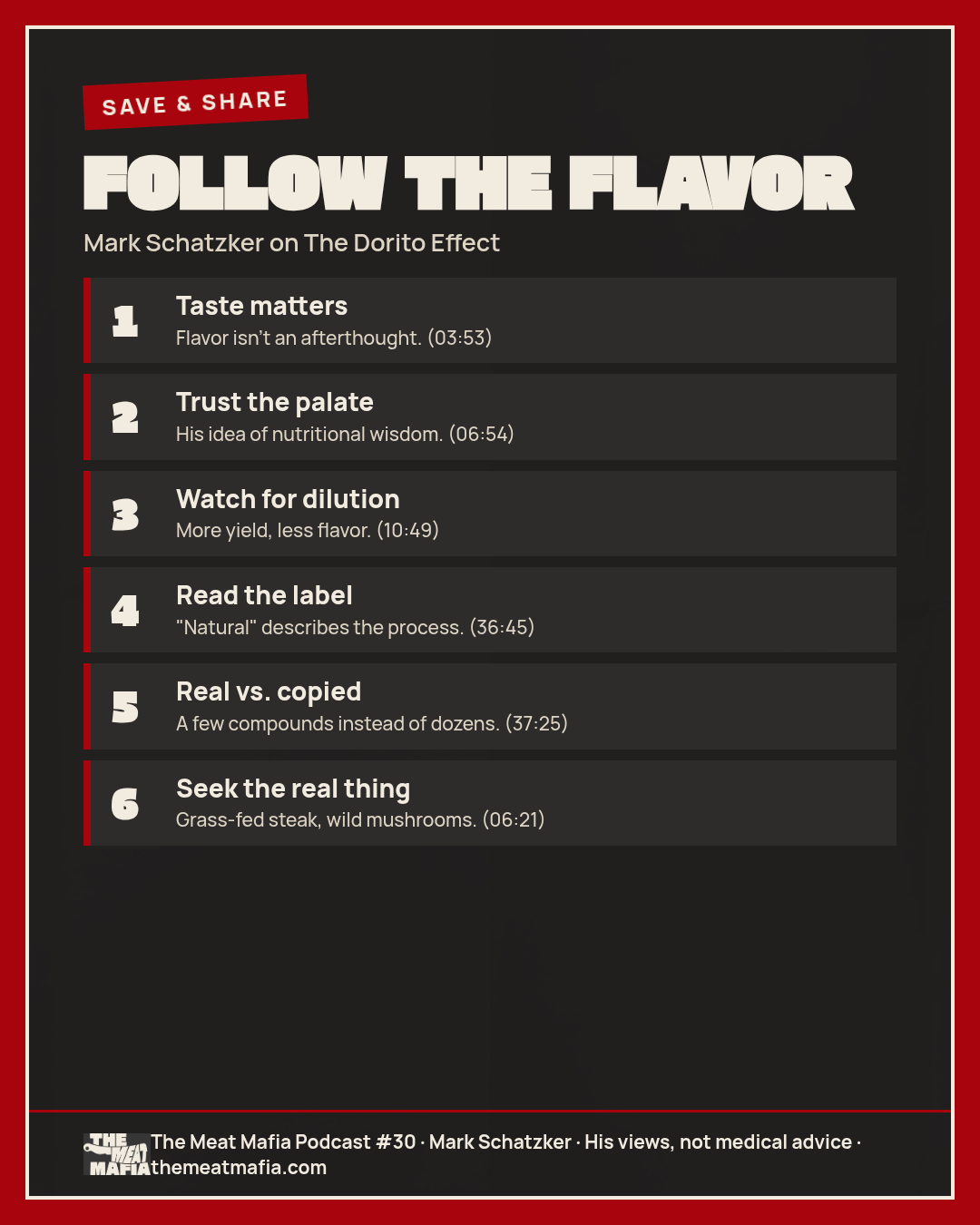
- Schatzker says most modern steak tastes bland compared with how it used to (03:01).
- He calls our built-in food sense "nutritional wisdom," based on Fred Provenza's research on animals (06:54).
- He says breeding and growing for yield dilutes both nutrition and flavor (09:50 to 10:49).
- He says the label "natural flavors" describes the process, not the source (36:45).
- He says lab-made flavors use only a few of the compounds in the real thing (37:25).
The dilution effect
Schatzker says we've bred plants to be more productive and grow them with lots of water, fertilizer and protection. That means more food, but in his view food that is "less food-like" (09:50 to 10:48).
What "natural flavors" means
He explains that "natural" on a label refers to how a flavor was made, not that it came from the food it tastes like (36:22 to 37:11).
A simpler orange
He says a real orange flavor has dozens of compounds, while a manufactured one may use just a handful because that's cheaper (37:25 to 37:35).
FAQ
What is The Dorito Effect? Mark Schatzker's book arguing that whole food has lost flavor while processed food has gained it through flavor chemistry.
What is the dilution effect? His term for how high-yield farming can water down both nutrition and flavor (09:50).
What does "natural flavors" mean? He says it describes how the flavor was made, not that it came from the named food (36:45).
Related on The Meat Mafia
- Jason Karp on processed food
- Calley Means on the food system
- More on Seed Oils & Ultra-Processed Food
- Browse all episodes
Get the free guide: 100 Books to Transform Your Health. Join the Meat Mafia email list and we'll send it to you.
Not medical advice. This post summarizes a podcast conversation for education. The views are the guest's own. Talk to a qualified clinician before you change your diet, supplements or any medication.