Dr. Marty Makary on Medicine's Blind Spots: What Doctors Got Wrong and What's Changing
Johns Hopkins surgeon Dr. Marty Makary explains the blind spots in modern medicine, from the white coat era to birth practices, food and the two blood tests he wants people to ask about.

By The Meat Mafia (Harry Gray and Brett Ender)
Dr. Marty Makary sat down with us in Texas, and before Harry could ask a single question, he opened with a list. It's the most quoted minute we've ever recorded, and it sets up everything that follows.
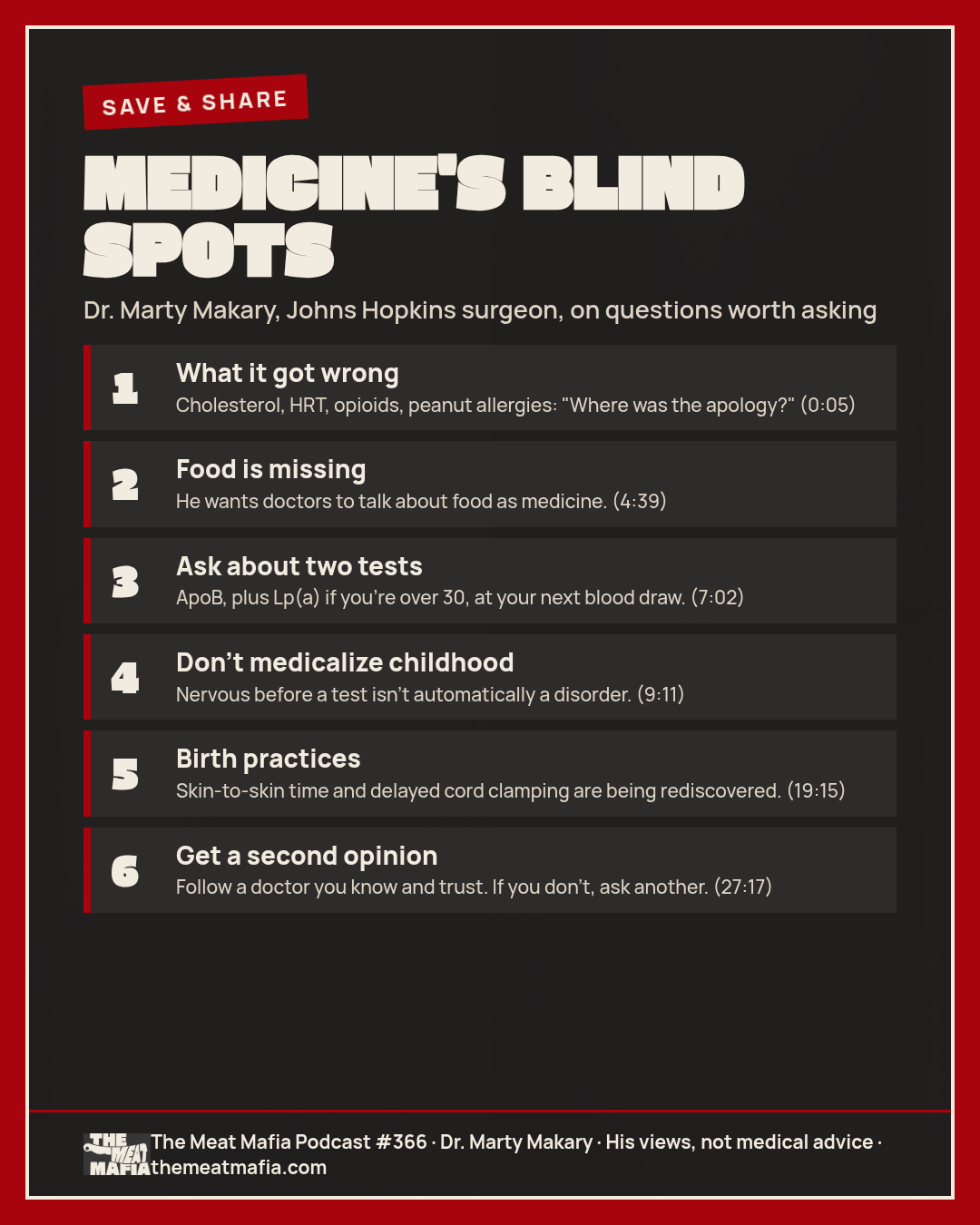
"we got cholesterol wrong for 60 years. Where was the apology?" (~00:05)
He kept going. Hormone replacement therapy, wrong for 22 years by his count. Opioids, wrong for 35 years, sold as not addictive. Peanut allergies, wrong for 17 years, when moms were told to keep peanut products away from young kids. In his telling, the advice had it backwards.
What makes Marty interesting is that he isn't an outsider throwing rocks. He's a surgeon and a professor at Johns Hopkins. He says the system attracts "really good people," kids who tell their high school friends they want to be a nurse or a doctor because they want to help. Then the culture of medicine beats a lot of that out of them.
Instead, he says, they're told to pick an organ from the anatomy atlas and stay in that lane for life. Patients get 15-minute visits, a vague "eat better, exercise more," a prescription and a scolding six months later for being noncompliant. "The patients hate it, we hate it," he told us.
So how did doctors get this much unquestioned authority? Marty took us back. For most of history, he says, doctors had little to offer: bloodletting with a lancet, and a saw for amputations. In the UK they were called barber surgeons. Then came penicillin, mass-produced after World War II. Doctors put on white coats and controlled who got the magic pill. He calls it the white coat era.
The pendulum swung toward intervening, he says, and in places it swung too far. His own nephew was whisked to the neonatal ICU the second he was born, about a dozen years ago, for what Marty calls a borderline bilirubin reading. The baby was fine.
"We're converting America's children into a generation of patients." (~09:11)
He isn't against modern medicine. He repeated that antibiotics, C-sections and NICUs save lives. His point is that a new generation of doctors is asking better questions: can cooking classes do more for diabetes, can sleep and stress help blood pressure, can we finally talk about school lunches? That's what gives him hope.
That's the Marty Makary we sat down with: a Johns Hopkins surgeon who loves medicine enough to name its blind spots. Below is the rest of the conversation, from the white coat era to birth practices and the two blood tests he brings up. This is his view, not medical advice. Talk to your own clinician about any test or treatment.
Listen to the full episode · Watch on YouTube
TL;DR: Dr. Marty Makary says the healthcare system attracts good people but is "entirely broken": chronic disease keeps rising while the system rarely talks about food, inflammation or prevention. In Blind Spots he traces how medicine's unquestioned "white coat" authority grew after World War II, and he points to practices now being rethought, like skin-to-skin time and delayed cord clamping. His practical tip: ask about ApoB and Lp(a) on your next blood test.
Who is Dr. Marty Makary? A surgeon and professor at Johns Hopkins, a public-health researcher and the author of Blind Spots. On the episode he describes his research team at Johns Hopkins, which studies the big topics medicine isn't talking about.
Key takeaways
- He calls the system "entirely broken" while praising the people in it (~02:01).
- Chronic disease keeps rising, and he says the average American is on four medications and the average senior on more than six (~07:02).
- He suggests asking about ApoB, and Lp(a) if you're over 30, at your next blood test (~07:02).
- Modern medicine's "white coat era" began after World War II with penicillin and hospital technology (~11:13).
- He points to delayed cord clamping and skin-to-skin time as practices hospitals are rediscovering (~19:15).
Why he says the system is broken
Marty's critique is about structure, not people. Short visits and a culture that trains doctors to specialize early leave little room for food, inflammation or environmental exposures. He wants doctors asking, "Can we talk about food as medicine?" He also worries about children being diagnosed for ordinary parts of life, like being nervous before a test.
The white coat era
Before antibiotics, he says, a doctor had about the same standing as a barber. Penicillin and new hospital technology changed that, and for decades doctors' authority went unquestioned. He says the upside was real: infant and maternal deaths had been devastating for all of human history. The downside, by his account, was the medicalization of ordinary life.
Birth, the microbiome and second opinions
He walked us through practices being reconsidered: early breastfeeding, skin-to-skin "kangaroo care," delayed cord clamping and avoiding C-sections when they aren't needed. He cites a randomized trial finding 90 seconds of delayed clamping better than 45. He's clear that C-sections and NICUs save lives and that you should follow a doctor you trust. If you don't know your doctor well, he suggests a second opinion.
Two blood tests he brings up
Marty says the "HDL good, LDL bad" shorthand is too simple. He suggests asking about apolipoprotein B (ApoB) and lipoprotein(a), or Lp(a), at your next blood test, Lp(a) especially if you're over 30. Talk to your clinician about whether they make sense for you.
(Timestamps are approximate.)
FAQ
Who is Dr. Marty Makary? A Johns Hopkins surgeon and professor and the author of Blind Spots, a book about the big topics he says modern medicine overlooks.
What does Dr. Makary mean by medical blind spots? Topics he says medicine rarely discusses, like food, whole-body inflammation and the lipoprotein picture, along with past advice he says was wrong for decades, such as on peanut allergies (~00:05, ~07:02).
Which blood tests does Dr. Makary suggest? He suggests asking about ApoB and, if you're over 30, Lp(a) at your next blood test (~07:02). Discuss it with your own clinician.
Is Dr. Makary against modern medicine? No. He says antibiotics, C-sections and NICUs save lives. His criticism is of overuse and of a system that leaves out prevention.
Related on The Meat Mafia
- Chris Kresser on why chronic disease keeps rising
- Dr. Ken Berry's proper human diet
- More on Root-Cause Medicine
- Browse all episodes
Get the free guide: 100 Books to Transform Your Health. Join the Meat Mafia email list and we'll send it to you.
Not medical advice. This post summarizes a podcast conversation for education. The views are the guest's own. Talk to a qualified clinician before you change your diet, supplements or any medication.