Can You Trust "Product of USA" Beef? Will Harris on Regenerative Farming
Fourth-generation rancher Will Harris explains why he left industrial cattle, what regenerative farming means at White Oak Pastures, and how to vet a farm.
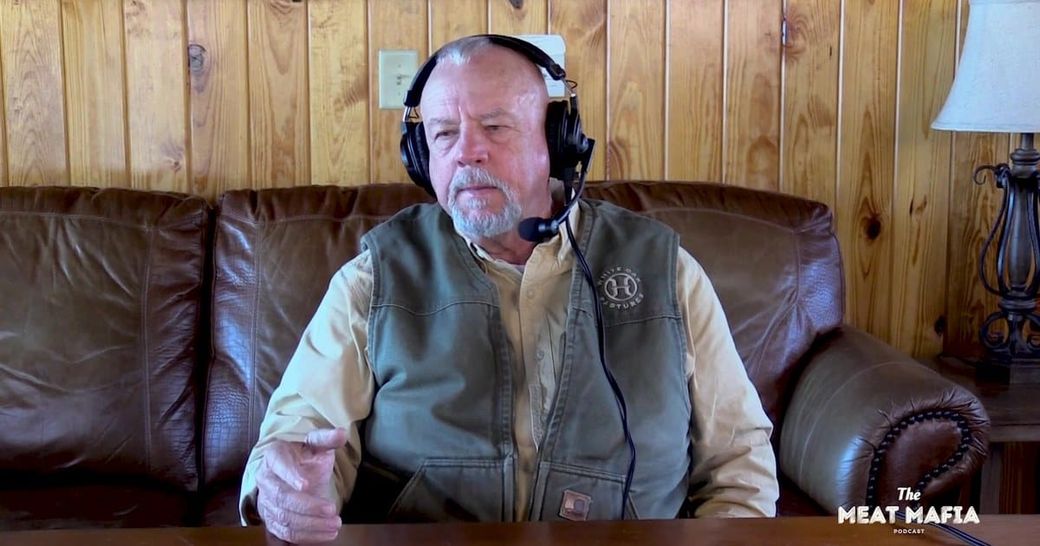
By Harry Gray & Brett Ender · The Meat Mafia Podcast · Episode #160 · Recorded at White Oak Pastures, Bluffton, GA · Aired March 13, 2023 · Updated October 27, 2026
Some links below are paid links. The Meat Mafia earns a commission if you buy through them or use code MEATMAFIA, at no extra cost to you.
The night before we recorded, we slept in the little pond house at White Oak Pastures. Will and his wife lived in that same house back in the seventies. It's a good place to start his story, because the whole thing is about a family staying on one piece of land and one man deciding how he wanted to farm it.
The Harris story in southwest Georgia starts with a Civil War. Will's great-grandfather, James Edward Harris, was a senior at Mercer University when war broke out in 1861. He and his classmates left school to form a cavalry unit, and he fought the war as a cavalry captain. Family lore, which Will is careful to call lore, says that near the end he mortgaged his farm in Quitman County to supply his own unit, expecting to be repaid when the South won. The bank took the farm. An uncle, a doctor in nearby Bluffton, helped him start again on the land that's now White Oak Pastures.
From there it passed from father to son. Will's grandfather, Will Carter Harris, added to it. His father, Bill Harris, added to it. Then came Will, "no middle initial," as he puts it, who added to it too.
Will says he never wanted to do anything else. While other boys wanted to be firemen or ballplayers, he just wanted to come home and run the farm. He studied animal science at the University of Georgia, came back, and joined his father, whom he describes as a very industrial and very successful cattleman. For about twenty years, first alongside his dad and then on his own, Will ran the place the modern way: pesticides, chemical fertilizer, antibiotics and hormone implants.
Here's the part we didn't expect. It worked. Will says he never lost money in a single year of farming industrially. His father remembered fertilizer salesmen in the late '40s and early '50s throwing barbecues to win over farmers, and Will doesn't blame anyone who signed up: "it looked like magic."
What changed was Will. The things that excited him in his twenties and thirties excited him less in his forties. He kept noticing what the chemicals were doing to the land, and comparing a treated field with the woods next to it. He's quick to tell you this wasn't a climate epiphany. In 1995, as he puts it, a 40-year-old Will Harris didn't walk outside thinking about saving the planet.
"I just didn't like what I saw here on the ground." (10:34)
So he started giving things up, one at a time. He had no grand plan, he says, just stopping what he didn't like. That came with a withdrawal period: productivity fell, and he couldn't know it would ever recover. It did. Back then he assumed he was the only one doing it. He later found out his friend Gabe Brown was making the same switch at the same time, up in North Dakota.
Three decades later, the farm he almost didn't change looks very different. By Will's count, he went from about three minimum-wage employees under the industrial model to more than 80 people today, in a small town. The part he's proudest of didn't make any spreadsheet. Two of his three daughters came home, and the sixth generation is now growing up on the farm. He's careful about that too. His goal was to give his kids
"an opportunity to come back, but not the obligation to come back." (1:48:27)
That's the Will Harris we sat down with: a man who walked away from a model that was making him money because of what he saw on his own land. Below is the rest of the conversation, from his three priorities for a farm to why he says you can't rely on a label to tell you where your beef came from.
Listen to episode #160 · Watch on YouTube
TL;DR: Will Harris didn't leave industrial cattle farming because it lost money. He left because he didn't like the effects of chemicals, antibiotics and hormone implants he saw on his land. He says you can't rely on USDA labels alone, since "Product of USA" beef can come from animals raised abroad, so research or visit farms and buy as locally as you can.
Who is Will Harris? A fourth-generation cattleman who runs White Oak Pastures in Bluffton, Georgia, a family farm dating to 1866 by his account (he traces the family back to 1861 on the episode). He farmed industrially for about 20 years before switching to regenerative methods.
Key takeaways
- He didn't leave industrial farming over money. "I never lost money any year operating industrially" (06:10). He left because "I just didn't like what I saw here on the ground" (10:34).
- He focuses on three things: regenerating the land, animal welfare and community (25:13–26:14).
- A farm revived a town. He says he went from about three minimum-wage employees to 80-plus, with payroll "over a hundred thousand dollars a week" (28:37).
- Labels aren't enough. "you certainly can't depend on USDA labeling", and beef labelled Product of USA can come from animals raised abroad (48:54–49:20).
- Cheap food isn't cheap. "It's just that the cost have been externalized." (1:14:26)
- He stays in his lane. He had his website scrubbed of nutrition and health claims: "I'm not the authority" (45:21–45:40).
Timestamped highlights
Times are from the podcast audio. The YouTube video may run a little offset.
| Time | Topic |
|---|---|
| 00:22 | Back at White Oak Pastures |
| 01:27 | The Harris family history, back to 1861 |
| 04:39 | Twenty years of industrial cattle |
| 06:35 | The unintended consequences he couldn't ignore |
| 09:50 | Why changing a working business is hard |
| 12:46 | Sponsor break (hosts) |
| 21:00 | Gabe Brown and the regenerative pioneers |
| 25:13 | Land, animals, community: the three things |
| 28:37 | How White Oak Pastures revived Bluffton |
| 36:20 | Big Ag, Big Food and whose interest is served |
| 38:51 | Industrialized, commoditized, centralized |
| 44:38 | Why he stopped making nutrition claims |
| 48:54 | Labels, certifications and "Product of USA" |
| 50:35 | Selling Whole Foods its first American grass-fed beef |
| 54:22 | How to vet a farm |
| 58:04 | The pandemic and supply-chain resilience |
| 1:04:29 | The cycles of nature, carbon and soil |
| 1:14:26 | The hidden costs of cheap food |
| 1:16:44 | The climate-smart commodity grant |
| 1:22:06 | On-farm slaughterhouses and USDA inspection |
| 1:26:13 | Raw milk laws in Georgia |
| 1:27:47 | Subsidies: "the only place… I'm a hypocrite" |
| 1:32:34 | Feed, closing loops and non-GMO poultry feed |
| 1:42:58 | Niche producer or the future? |
| 1:47:24 | Legacy and the next generation |
What regenerative farming means at White Oak Pastures
Will boils the farm down to three things: "the regeneration of the land, which to me is the restarting of the cycles of nature" (25:24); animal welfare, meaning letting animals "express instinctive behaviors" (26:14); and community. Later he explains the soil side with an image you won't forget: "It was like chocolate cake" (1:11:05).
The community piece is where the numbers come in. Will says that while he farmed industrially he had "about three minimum wage employees, payroll about a thousand dollars a week. And today, we got a 80 something employees. Payrolls over a hundred thousand dollars a week." (28:37)
Industrialized, commoditized, centralized
His diagnosis of the modern food system comes in three words:
"Three things have industrialized, commoditized, and centralized… the industrialization, that is changing the farm, from a very cyclical living system to a very linear industrial system." (38:51)
Commoditization, he says, is "a race to the bottom to make it as cheap as you can" (42:36), and that leads to the bill nobody sees:
"we talk about how cheap food is in the industrial system. Well, it's not that freaking cheap. It's just that the cost have been externalized." (1:14:26)
Can you trust "grass-fed" and "Product of USA" labels?
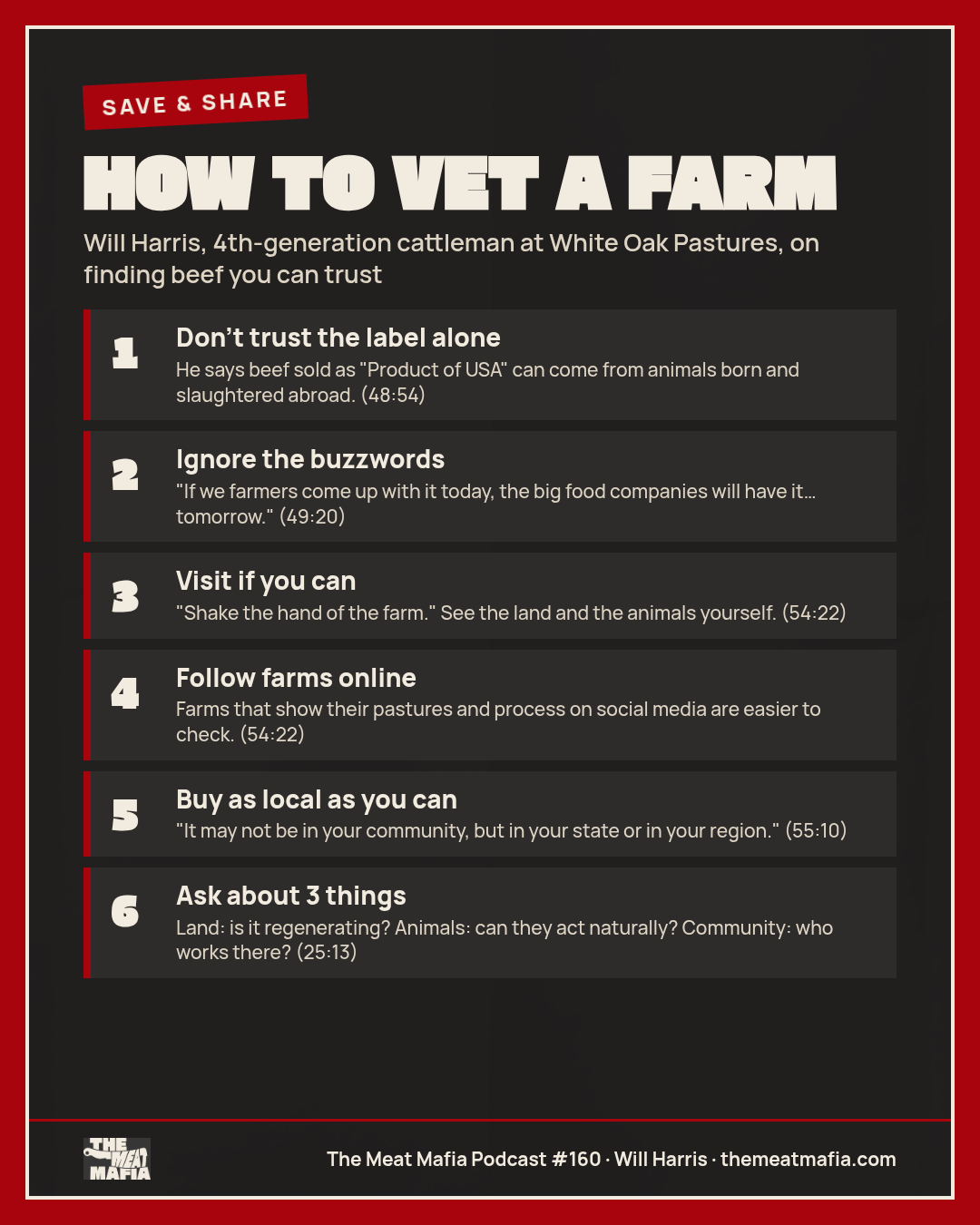
His short answer is no, not on their own:
"You can't depend on you certainly can't depend on USDA labeling… you can go to the grocery store and buy beef product of The USA that was born, slaughtered in Uruguay or Australia or New Zealand." (48:54)
Marketing words don't help much either: "If we if if we farmers come up with it today, the big food companies will have it emblazoned in pretty colors tomorrow." (49:20)
How to find a farm you can trust
Will's advice is unglamorous: "the consumers just gotta do some research" (54:22). Visit if you can ("shake the hand of the farm"), follow farms on social media, and "buy locally, as locally as you can. It may not be in your community, but in your state or in your region" (55:10). He's explicit that this isn't a pitch for his own farm: "I'm not just selling for white oak pasture. I'm talking about farms all across the country." (55:10)
A rancher who won't make health claims
For a health-focused show, this was refreshing. Will had White Oak Pastures' website stripped of nutrition and health claims:
"I think I think a lot of it's true, but I'm not the authority. I am the authority on, I don't know, welfare, land stewardship, and community building." (45:40)
Resources & brands from this episode
- White Oak Pastures (guest brand): whiteoakpastures.com · blog · 2019 Quantis life-cycle assessment (PDF).
- Sponsors read on this episode: Carnivore Bar, Holy Cow Beef and Perennial Pastures.
FAQ
What is regenerative farming, according to Will Harris? To him it means restarting "the cycles of nature" that industrial farming breaks (carbon, water, mineral, microbial and energy cycles) while also prioritizing animal welfare and the local community (25:24, 1:04:29).
Why did Will Harris stop farming industrially? Not for money. He says he never lost money operating industrially. He became uneasy with the unintended consequences of pesticides, chemical fertilizers, antibiotics and hormone implants (06:10–10:34).
Can I trust a "Product of USA" label on beef? Will says you can't rely on USDA labeling alone. He says beef from animals born and slaughtered abroad can carry the label (48:54). He suggests researching or visiting farms and buying as locally as you can (54:22–55:10).
Is grass-fed beef healthier? Will deliberately doesn't make nutrition claims ("I'm not the authority", 45:40). For the nutrition side, see our episodes with doctors and researchers. This one is about land, animals and community.
Related episodes
- #150 Joel Salatin: Why Cheap Food Costs More
- #274 Brett & Harry: Where to Buy Grass-Fed Beef
- Pillar hub: Regenerative food system → /health/regenerative-food/
Get the free guide: 100 Books to Transform Your Health. Join the Meat Mafia email list and we'll send it to you.
Disclosure: Meat Mafia hosts Harry Gray and Brett Ender co-own Noble Origins, a grass-fed beef protein with organs. We mention it where it is relevant, so weigh our take with that in mind.
Not medical advice. This post summarizes a podcast conversation for education. The views are the guest's own. Talk to a qualified clinician before you change your diet, supplements or any medication. Raw milk laws vary by state.