Why Cheap Food Costs More: Lessons From Joel Salatin at Polyface Farm
Farmer Joel Salatin explains why participation in your food matters, why resilience beats efficiency, and what cheap food costs farmers, recorded at Polyface Farm.
By The Meat Mafia (Harry Gray and Brett Ender)
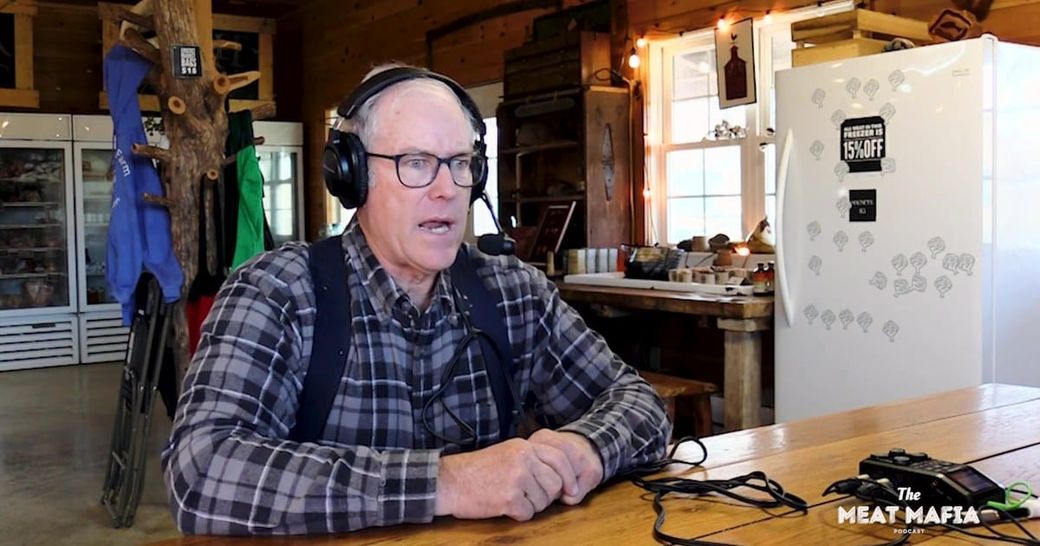
This was the last stop of our road trip. A few days earlier we'd been at White Oak Pastures with Will Harris, and now we were sitting across from Joel Salatin at Polyface Farm. It was our second episode with Joel but the first in person, and the story he told us starts with a piece of land nobody would have picked.
Joel's family came to the farm in 1961. His dad wanted to make a living farming, but, Joel says, he quickly gave that up. The land wasn't much to look at.
"the farm was a gully worn out rock pile" (36:21)
There was a mortgage to pay and a young family to feed, so both parents worked off the farm. His mom taught school. His dad did bookkeeping, accounting and tax preparation for a firm. Those off-farm paychecks covered the mortgage, and within ten years the farm was paid off.
It wasn't a real business back then. Joel calls it basically a homestead. They milked cows, kept a garden and even did their own butchering. Joel started his own egg business at 10 years old. When he was home from college, summers had a rhythm: June was for making hay, July for a big project, and August for cutting firewood so his parents wouldn't freeze while he was away.
They bought very little. They canned, froze corn from the garden, churned butter, and made yogurt and cottage cheese. They picked neighbors' apples for applesauce and stored bushels of them in the well pit like a root cellar. They dug five, six, seven hundred pounds of potatoes and kept them under straw in the barn. His mom would fill a five-gallon bucket from the pile.
"if we could figure out how to grow Kleenex and toilet paper, we could pretty much pull the plug on society" (38:06)
He thought that was normal, he says, and later found out it wasn't. Fifty years on, the change he notices most in customers is that a lot of people no longer know how to cook. Some ask him how to make a hamburger.
Then came 2020. The store shelves went bare and people panicked, and Polyface sold six months' worth of food in six weeks. People who'd said they'd never pay those prices showed up because the supermarket had nothing. To Joel, it showed that the way he grew up, which the culture had treated as a little odd, was really a form of freedom.
That's the Joel Salatin we sat down with: a farmer raised on a paid-off rock pile who thinks every household should be able to feed itself a little. He's optimistic, too. His apprentice program gets about a hundred applicants a year for 11 spots. Below is the rest of the conversation, from why participation is freedom to resilience over efficiency and what cheap food costs farmers.
Listen to the full episode · Watch on YouTube
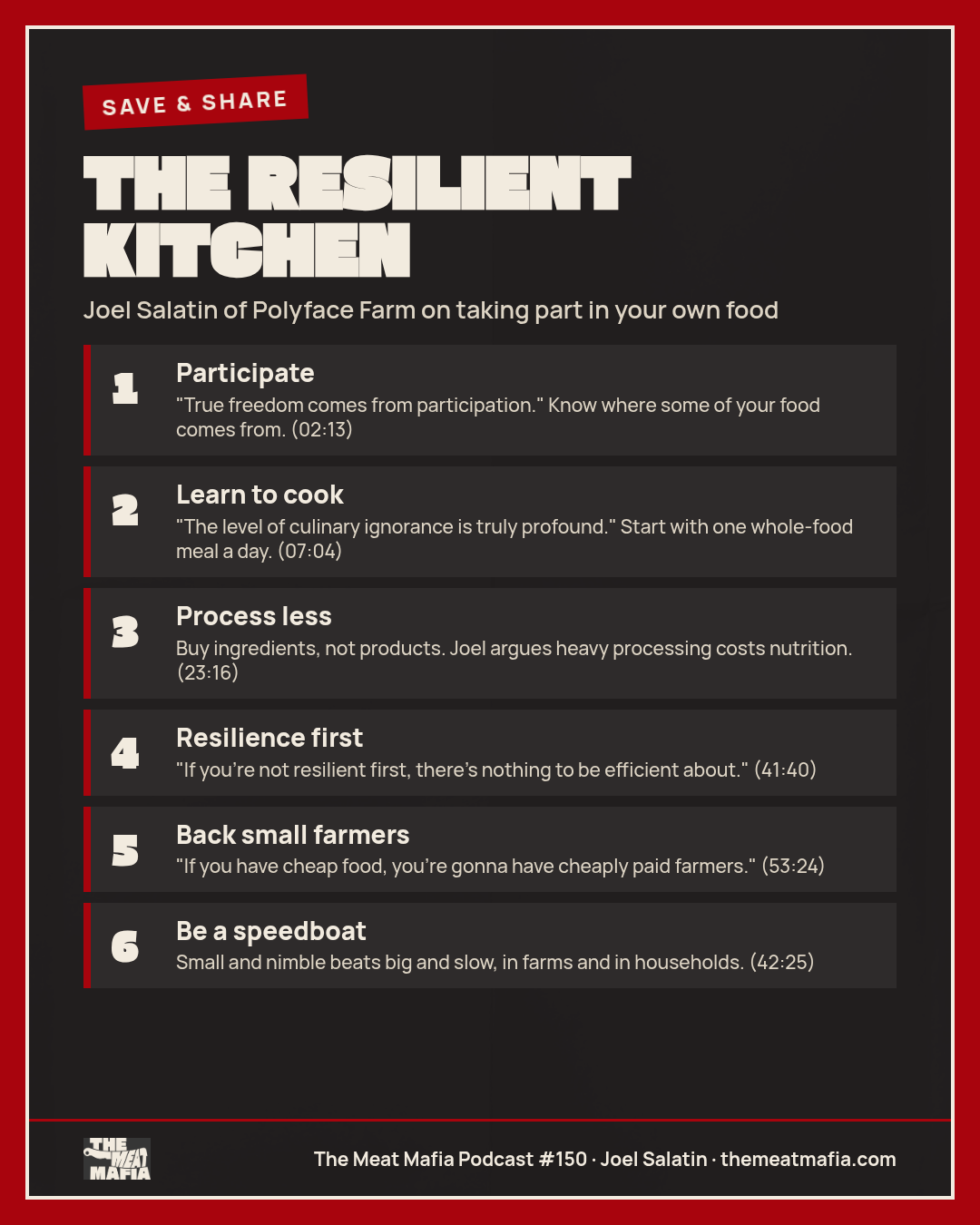
TL;DR: Joel Salatin's main idea is that "true freedom comes from participation": know where your food comes from, cook it yourself and buy from farmers you know. He argues a resilient food system beats an efficient one, and that "if you have cheap food, you're gonna have cheaply paid farmers."
Who is Joel Salatin? A third-generation farmer at Polyface Farm in Swoope, Virginia, known for pasture-based, rotational grazing. He has written more than a dozen books, including Folks, This Ain't Normal, and appeared on The Joe Rogan Experience.
Key takeaways
- Joel's definition of freedom: “true freedom comes from participation.”(02:13)
- He's blunt about how little people know about food: “The level of of, of culinary ignorance is truly profound”(07:04)
- His case for resilience: “if you're not resilient first, there's nothing to be efficient about.”(41:40)
- Small and nimble beats big: “You wanna be a speedboat.”(42:25)
- On the price of cheap food: “if you have cheap food, you're gonna have cheaply paid farmers.”(53:24)
Participation is freedom
Joel's view is that you can't be free if you depend on someone else for everything you eat. Knowing where food comes from, and making some of it yourself, is the start.
Processing, nutrition and the kitchen
Joel argued that the more we process food, the more we lose:
“all processing destroys nutrition.”(23:16)
That's his broad rule of thumb, not a scientific absolute. Some processing, like cooking or fermenting, can make nutrients easier to absorb. His practical point is to buy ingredients rather than heavily processed products and to cook more at home.
Resilience over efficiency
Joel contrasts the giant, centralized food system with small, nimble producers.
“every paradigm eventually exceeds its point of efficiency.”(46:58)
He sees a groundswell of people growing their own food and calls it a homestead tsunami.
FAQ
What does Joel Salatin mean by food freedom? He says "true freedom comes from participation": knowing where your food comes from and producing or preparing some of it yourself (02:13).
Why does Joel Salatin say cheap food is a problem? "If you have cheap food, you're gonna have cheaply paid farmers" (53:24).
What is Joel Salatin's view on resilience? "If you're not resilient first, there's nothing to be efficient about." He favors small, nimble producers (41:40–42:25).
Where is Polyface Farm? In Swoope, in Virginia's Shenandoah Valley. This episode was recorded in person at the farm.
Related on The Meat Mafia
- Episode #150 show notes
- Episode #75: Joel Salatin on Changing the World Through Better Food & Health
- Will Harris: Can you trust "Product of USA" beef?
- Regenerative food hub
Get the free guide: 100 Books to Transform Your Health. Join the Meat Mafia email list and we'll send it to you.
Disclosure: Meat Mafia hosts Harry Gray and Brett Ender co-own Noble Origins, a grass-fed beef protein with organs. We mention it where it is relevant, so weigh our take with that in mind.
Not medical advice. This post summarizes a podcast conversation for education. The views are the guest's own. Talk to a qualified clinician before you change your diet, supplements or any medication.