Jason Karp on Food Dyes, Froot Loops and Why Shoppers Have More Power Than They Think
Investor and HumanCo founder Jason Karp on his Kellogg's letter, the US vs. Canada Froot Loops comparison, artificial food dyes and why he thinks shoppers can move big food companies.

By The Meat Mafia (Harry Gray and Brett Ender)
Jason came into the studio a couple of weeks after speaking at a Senate roundtable on health and nutrition. We expected to talk about the event. What we got was a lesson in how one investor decided to take on a cereal box.
Jason spent his career as a professional investor, and part of that job was shareholder activism: writing letters and applying pressure until a company changes how it behaves. He says that in many instances, it works.
He'd also been paying attention to food for a long time. Before most people had heard the phrase, he was running Hu Kitchen in New York without seed oils. Today his company, HumanCo, backs brands trying to make better versions of the foods people already buy.
So when he noticed that the same cereal looked different across the border, he did what an activist investor does. In March he wrote a shareholder letter to Kellogg's, and its whole argument fit in one sentence.
"shouldn't American families and American children receive the safest and best version of a product that you already make?" (17:00)
By his account, Kellogg's answer was that kids prefer brighter colors. Jason's reply: kids will pick a lot of things that aren't good for them, and that doesn't make it right.
At the roundtable he pulled out two bags of Froot Loops, one from the US and one from Canada. The American cereal looked neon. The Canadian one was muted. He says the audience gasped.
He isn't pushing sugar cereal. He's blunt that he doesn't recommend it at all. His point is that if millions of families are going to buy it anyway, it should be made the cleaner way the company already knows how to make. And he doesn't think the fastest path runs through regulators.
"consumers have far more power with their wallets than we realize" (34:00)
That's the Jason Karp we sat down with: an investor who spent years on these issues and decided to use the tools he knew. Below is the rest of the conversation, from food dyes and ingredient rules to what shoppers can do and why he says family and community matter as much as the food on the plate. This is his view, not medical advice.
Listen to the full episode · Watch on YouTube
TL;DR: Jason Karp came on right after speaking at a Senate roundtable on health and nutrition, and he kept the focus on food. His main example: Froot Loops sold in the US use synthetic dyes and look neon next to the muted Canadian version, which he says is colored with fruit juice. He wrote a shareholder letter asking Kellogg's to give American kids the same version, and he argues the fastest change comes from shoppers choosing what they buy. These are his views, not medical advice.
Who is Jason Karp? A former hedge fund investor and the founder of HumanCo, which invests in better-for-you food and wellness brands, including Hu Chocolate (which began as Hu Kitchen in New York). He spoke at a Senate roundtable on health and nutrition shortly before this episode.
Key takeaways
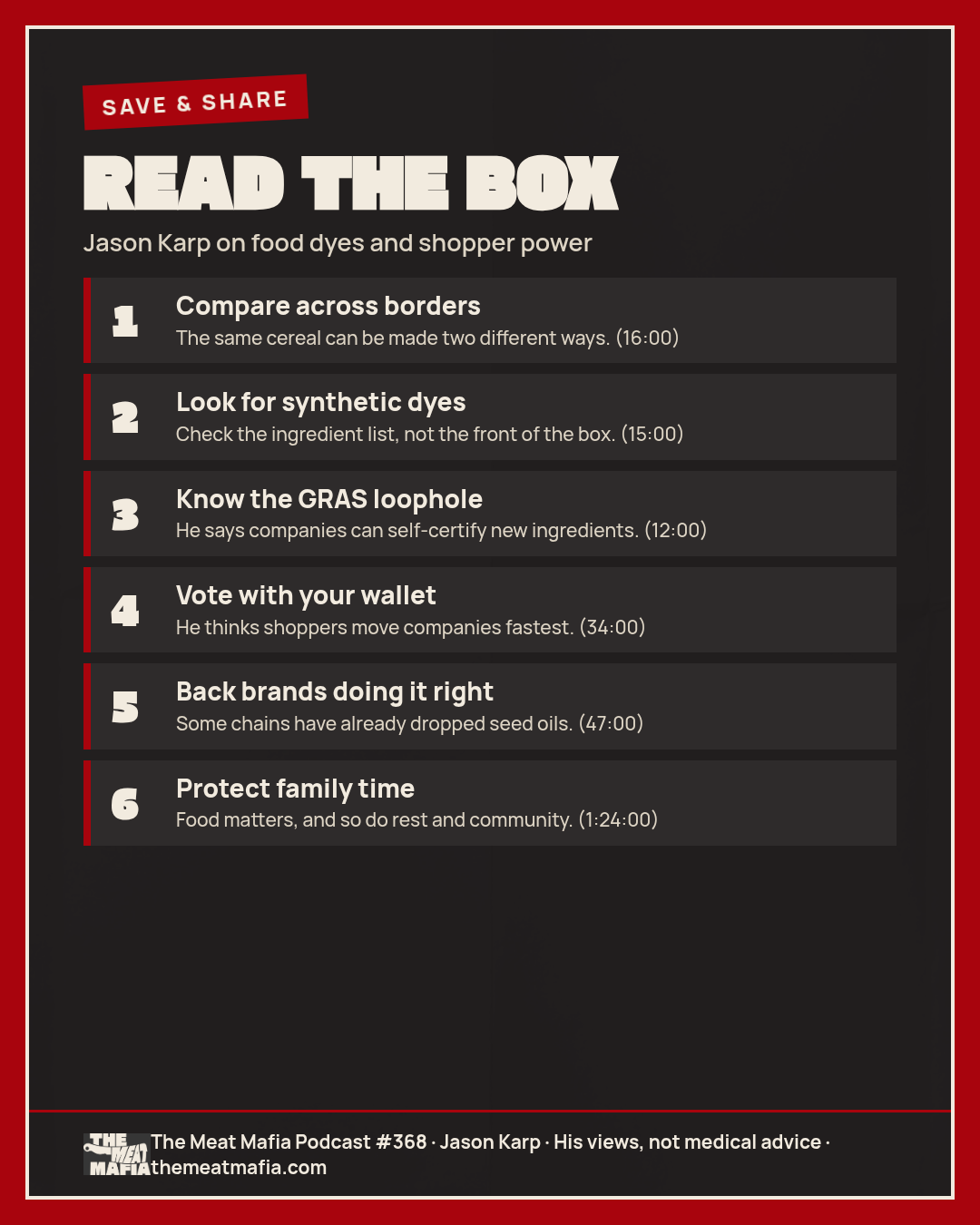
- He wrote a shareholder letter to Kellogg's asking for the same dye-free recipe it makes elsewhere (17:00).
- At the roundtable he compared US and Canadian Froot Loops side by side (16:00).
- He says the US lets companies self-certify new ingredients as "generally recognized as safe" (12:00).
- He thinks shoppers voting with their wallets is the fastest lever for change (34:00).
- He says some brands, like Sweetgreen, have already shown dropping seed oils can be done (47:00).
The Froot Loops test
Jason's favorite visual is simple: the same brand, two countries, two colors. He says the US version uses synthetic, petroleum-derived dyes, while the Canadian version is colored with fruit juice. His argument isn't that cereal is health food. It's that a company already knows how to make the cleaner version.
How ingredients get approved
He describes the US "generally recognized as safe" (GRAS) pathway, where he says a company can hire its own experts to declare a new ingredient safe without FDA approval. He contrasts that with countries he says take a more cautious approach. His broader point is to use common sense instead of waiting decades for perfect studies.
Voting with your wallet
Jason says change can come top-down from rules or bottom-up from shoppers, and bottom-up is faster. Big public food companies watch sales closely, so he wants consumers to share factual information and choose different products. He says he has also helped open-minded companies reformulate.
Beyond the plate
Late in the episode he talks about his years as a data-driven investor who treated sleep as something to shortcut, and how that changed after a long illness. Today he puts family, community and rest at the center, and he suggests a weekly break from screens.
FAQ
Who is Jason Karp? A former hedge fund investor and the founder of HumanCo, which invests in better-for-you food and wellness brands, including Hu Chocolate.
What did Jason Karp ask Kellogg's to do? In a shareholder letter, he asked Kellogg's to sell American families the same version of its products it already makes for other countries, without synthetic dyes (~17:00).
What is GRAS? "Generally recognized as safe." Karp says this US pathway lets companies self-certify new food ingredients without FDA approval (~12:00).
What does Jason Karp say shoppers can do? He says consumers have more power with their wallets than they realize, and that buying choices move big food companies faster than rules do (~34:00).
Related on The Meat Mafia
- Dr. Marty Makary on medicine's blind spots
- Jenni Harris on finding real regenerative meat
- More on Regenerative Food & MAHA
- Browse all episodes
Get the free guide: 100 Books to Transform Your Health. Join the Meat Mafia email list and we'll send it to you.
Not medical advice. This post summarizes a podcast conversation for education. The views are the guest's own. Talk to a qualified clinician before you change your diet, supplements or any medication.