Jenni Harris of White Oak Pastures on Regenerative Farming and a Resilient Food Supply
Jenni Harris, fifth generation at White Oak Pastures, on her dad's switch to grass-fed, building an on-farm processing plant, staying open through COVID and finding real regenerative meat.
By The Meat Mafia (Harry Gray and Brett Ender)
We have been lucky enough to visit White Oak Pastures in Bluffton, Georgia, and we'd had Jenni's dad, Will, on the show not long before. Jenni's side of the story is the one we hadn't heard: what it was like to grow up inside the change.
As a little girl she would get angry if her dad left for work without her. She'd make her mom call him so he'd come back and pick her up. It wasn't the work that mattered, she told us. It was being with him: playing in the woods, riding the tractor, feeding the cows.
Her grandparents were careful people. If they couldn't pay cash for something, they didn't have it, and they drove the same vehicle for 20 years. Will swung the other way at first and ran the farm hard on the industrial model. Then, slowly, he grew disgusted with what it was doing to the land.
In the mid-nineties he quit using chemical fertilizer. He had a line for why.
"Chemical fertilizer is like peeing in your pants to stay warm." (05:00)
The short term was ugly. Jenni remembers it plainly: the grass was brown and the cows were hungry, while her dad talked about a big vision of grass-fed beef. She calls it a swing for the fences, and says the timing was lucky. People were starting to care about nutrition, land and rural towns.
The next wall was processing. Selling cows was easy; turning them into beef they could stand behind meant relying on outside plants. So the family built its own USDA-inspected processing plant, finished in 2008. She says it didn't take cost out. It let them operate at a level that justified being in the business.
That choice paid off when COVID hit. The big packers she describes process 400 head an hour. White Oak does 25 head a day. When people got sick, their small crew covered for each other.
"we have not missed a day of processing" (17:00)
That's the Jenni Harris we sat down with: the fifth generation of a farm that bet on doing it the slow way. Below is the rest of the conversation, from processing and resilience to how to tell real regenerative meat from the buzzword, and how a family farm balances grocery stores with online sales.
Listen to the full episode · Watch on YouTube
TL;DR: Jenni Harris grew up following her dad, Will Harris, around the farm and watched him walk away from chemical fertilizer in the mid-nineties. She says the real bottleneck to growing a grass-fed brand was processing, so the family built its own USDA-inspected plant. By her account that small, local setup let them keep processing every day through the pandemic, while she warns that the word "regenerative" now gets used far more than it gets practiced.
Who is Jenni Harris? The fifth generation of her family at White Oak Pastures in Bluffton, Georgia, and the daughter of Will Harris. She works across the farm's wholesale, retail and e-commerce business.
Key takeaways
- Will Harris moved White Oak Pastures off chemical fertilizer in the mid-nineties, and the land looked rough at first (05:00).
- Processing was the growth bottleneck, so the family built an on-farm, USDA-inspected plant (11:00).
- She says a small 25-head-a-day plant proved more resilient than giant packers during COVID (16:00).
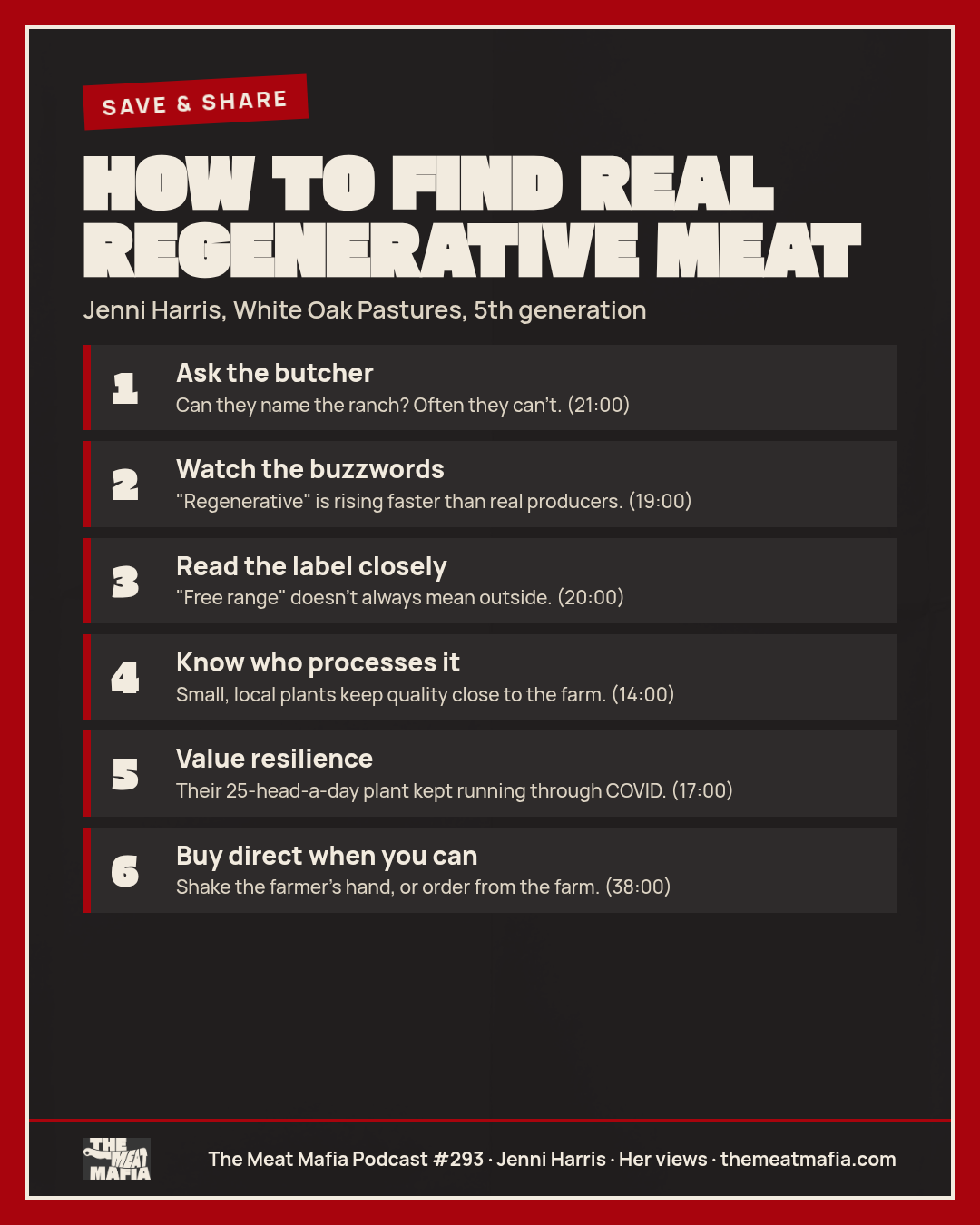
- She warns "regenerative" is a rising buzzword while authentic producers are getting fewer (19:00).
- A test she liked: ask the butcher which ranch the meat came from (21:00).
Why processing changed everything
Jenni says there used to be a butcher in every town before World War II, and food was local. Today a few huge companies handle most of the beef. Owning their own plant let White Oak control animal welfare and quality from pasture to package, and keep jobs in Bluffton.
Resilience during COVID
When grocery shelves emptied, the big plants slowed down because a single sick crew could stop a line. At White Oak, she says, people covered for each other. Their online sales jumped as shoppers looked for a farm they could buy from directly.
Regenerative, or just a label?
She sees more farms using the language and fewer doing the work. Her example is "free range" chicken, which she says can legally live mostly indoors. Her advice is to ask where the meat came from. If the store can't name a ranch, that tells you something.
Balancing wholesale and retail
Jenni walks through why the farm needs both grocery partners and direct sales: grocery orders can be seasonal, while a farm that raises animals all year needs steady demand. She talks about their long Publix partnership and how their Whole Foods relationship changed over the years.
FAQ
Who is Jenni Harris? The fifth generation at White Oak Pastures in Bluffton, Georgia, and the daughter of regenerative rancher Will Harris.
When did White Oak Pastures go grass-fed? Jenni says her dad started moving the farm to the grass-fed model in the mid-nineties, when he quit chemical fertilizer (~05:00).
Why did White Oak Pastures build its own processing plant? She says processing was the bottleneck to growth, and owning a USDA-inspected plant let them control quality and keep the business viable (~11:00).
How can you tell if meat is really regenerative? Her tip is to ask where it came from. If a butcher can't name the ranch, be skeptical, and read labels like "free range" carefully (~20:00).
Related on The Meat Mafia
- Will Harris on leaving industrial farming
- Joel Salatin on Polyface and food freedom
- More on Regenerative Food & MAHA
- Browse all episodes
Get the free guide: 100 Books to Transform Your Health. Join the Meat Mafia email list and we'll send it to you.
Not medical advice. This post summarizes a podcast conversation for education. The views are the guest's own. Talk to a qualified clinician before you change your diet, supplements or any medication.